
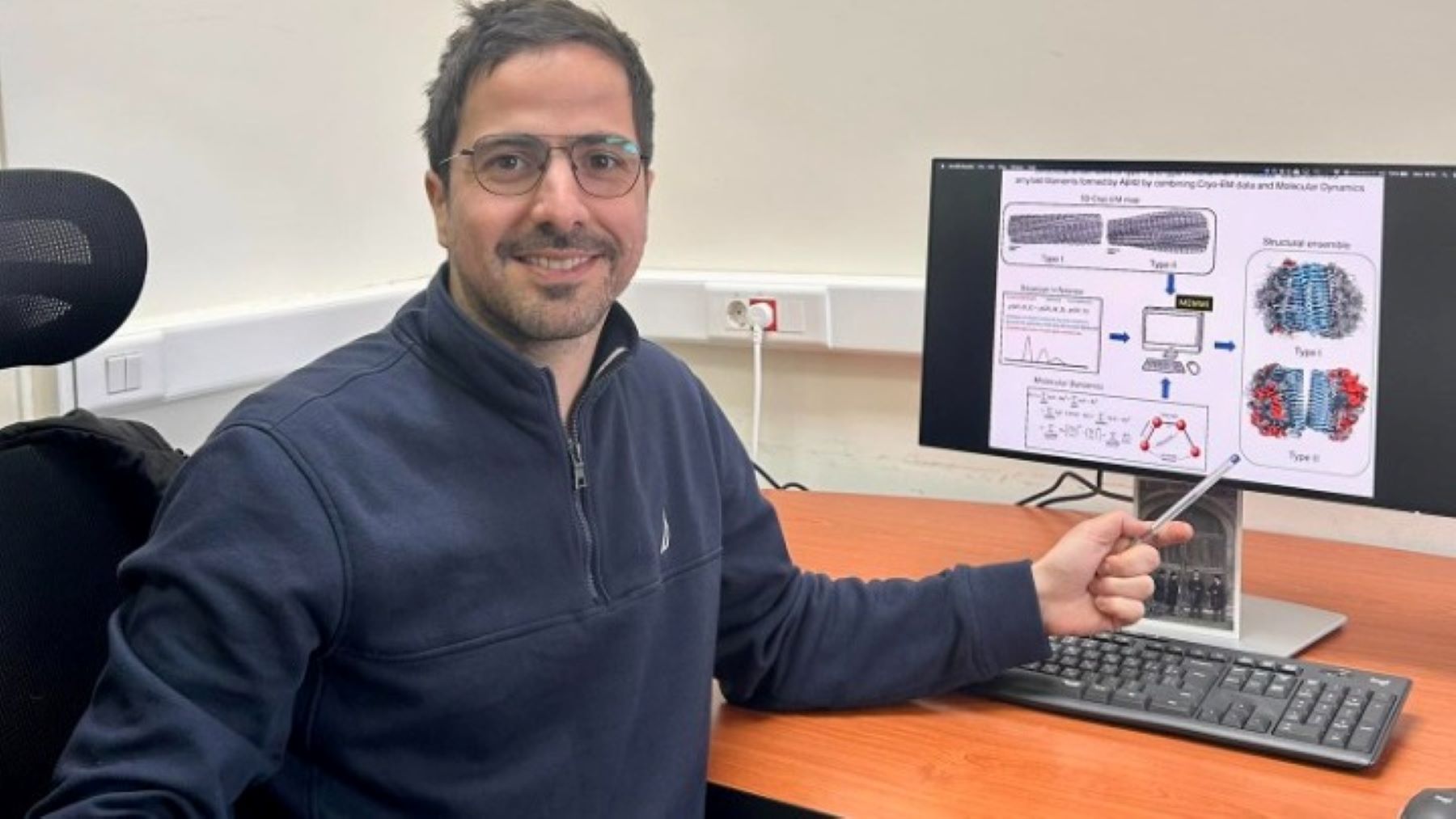
From Europe’s leading laboratories to research and teaching in Athens, the journey of Zacharias Faidon Brotzakis is a story of inspiration for every young scientist
“Research is not just phenomenology, it’s watching matter change form through our microscopic experiments,” says Faidon Brotzakis. Yet his own life also transformed step by step throughout his international research career, leading him to the Department of Biotechnology at the Agricultural University of Athens, where he has been serving as Assistant Professor since the beginning of this year.
Dr. Zacharias Faidon Brotzakis specializes in computational chemistry and biology with an emphasis on developing and applying novel computational methods for studying protein dynamics and for discovering potential therapeutics.
He began his studies as a Chemical Engineer at the National Technical University of Athens, where he discovered his early enthusiasm for the ability of computational models to predict molecular dynamics, during his diploma thesis under Prof. D. Theodorou.
He pursued his PhD at the University of Amsterdam (UvA), where, under the supervision of Professor P. Bolhuis, he specialized in molecular dynamics and delved into the theoretical background of statistical physics to understand the behavior of complex biomolecules such as protein folding and interactions.
Following his PhD, Brotzakis continued his research career in leading international laboratories. He conducted postdoctoral research at ETH Zurich with Professor M. Parrinello, an emblematic figure in the field of molecular simulations and at the University of Cambridge, where he collaborated with internationally recognized scientists in computational chemistry and biology. There, he further developed innovative methods for analyzing protein dynamics and predicting interactions with potential drug compounds.
In particular, at Cambridge, under the supervision of Professor M. Vendruscolo, he combined techniques from statistical physics and machine learning with experimental data to study how proteins move and change shape at the nanometer scale—a field with direct applications in understanding diseases such as Alzheimer’s and other neurodegenerative disorders.
This work proved especially significant, as in several cases his team developed algorithms that surpass even leading protein structure prediction methods, providing more accurate and useful predictions for the scientific community.
After returning from abroad, a pivotal step in his career was joining the laboratory of Georgios Skretas, Director of the Institute of Bioinnovation at the Biomedical Science Research Center “Alexander Fleming” (BSRC Fleming).
After all, he had expressed from the beginning his desire to complete his studies and return this knowledge to his country, Greece, thus contributing to the reversal of the brain drain.
Boosting bio-entrepreneurship
Brotzakis served as a senior postdoctoral researcher in Dr. Skretas’ laboratory, actively participating in the European research project ERA Chair “Boost4Bio” – Boosting Bio-Innovation and Bio-Entrepreneurship by Establishing Excellence in Biomolecular Engineering and Synthetic Biology, hosted by BSRC “Alexander Fleming.”
Boost4Bio is a major European Union funded program aimed at strengthening biotechnology and synthetic biology research in Greece, promoting innovation, and supporting the translation of research results into applications with real societal impact. These include the development of pharmaceutical molecules and the set of “Biotechnopolis,” an integrated biotechnology hub in Greece, the first in Balkan region.
Within this framework, Brotzakis contributed to the development and application of computational tools that integrate data and physics-based models to study the dynamics of proteins involved in disease. Part of this research includes studies on proteins such as Aβ42 and tau, which are associated with Alzheimer’s disease, with findings published in leading international scientific journals, contributing to the identification of potential new therapeutic targets.
“We want the Greek research ecosystem to contribute with findings that truly changes the world,” he notes.
Notably, in February 2025, as head of an international research team, he shed light for the first time on mysterious regions of pathological amyloid fibrils—proteins responsible for Alzheimer’s—opening new pathways for drug discovery. Shortly afterward, together with his colleagues, they found a way to investigate the structure of a significant fraction of all human proteins that until now seemed “dark” and unobservable, the intrinsically disordered proteins (IDRs), which concern approximately 30% of the human proteome (total proteins), and play important functional roles within the cell as interaction nodes during biological processes such as transcription, translation and signaling.
His significant contribution to understanding protein structure and dynamics, particularly those involved in Alzheimer’s and other neurodegenerative diseases, has been recognized through publications in international scientific journals and presentations at global conferences.
In addition, his research has been honored with the “G. Th. Foteinos” Award from the Academy of Athens, confirming the scientific value and innovation of his work.
Transmitting knowledge to the next generation
What inspires Brotzakis to continue his research is “the freedom and openness of thought, the independence of theory and practical applications, and their intersection with the goal of improving our lives. Studying deeply what interests you most in the most original way possible. The opportunity to pass on the spark of knowledge and experience to the new generation of scientists in Greece.”
At the beginning of the year, he announced the launch of his own laboratory at the Department of Biotechnology of the Agricultural University of Athens, where he will join forces with colleagues and young students interested in molecular simulations, integrative structural biology and computer-aided drug discovery.
“My academic journey across four countries gave me the opportunity to learn and work with leading scientists in molecular simulations, computational chemistry and biology. Now I want to pass on this knowledge and also learn from our students,” he emphasizes.
The path of Faidon Brotzakis impressively shows how experience in research laboratories, systematic participation in international scientific projects such as Boost4Bio, and global collaboration can guide a scientist from the early stages of education to an academic position—while simultaneously enabling them to contribute to scientific progress and innovation in their home country.
As for his message to all young scientists: “Do not be afraid to follow your instinct. The path is rarely a straight line. Dream big, and strive to collaborate internationally. Science today is global and Greece has the potential to make a significant contribution.”