
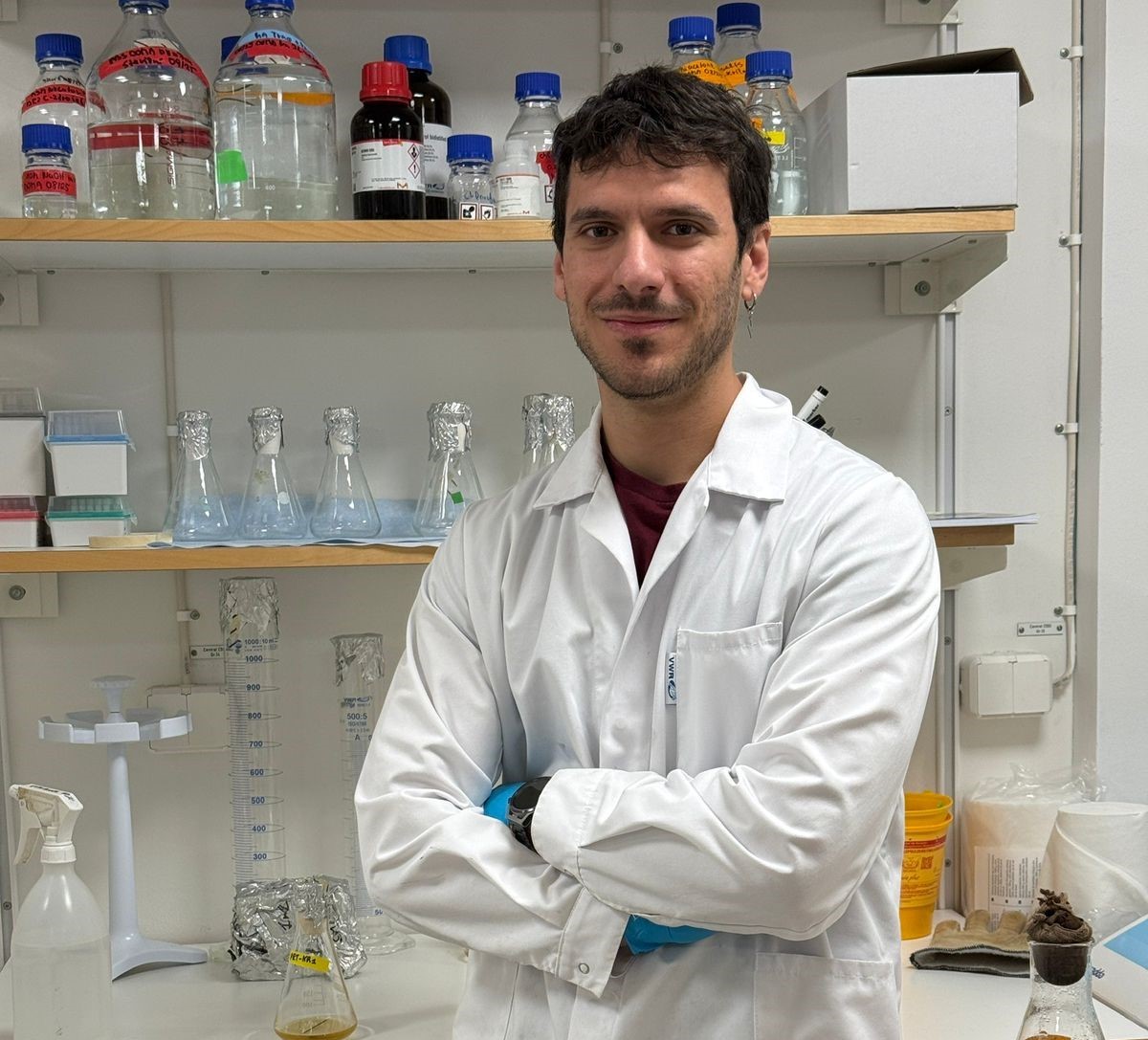
Konstantinos Rigkos, a PhD candidate at the University of Ioannina who is conducting his doctoral research in the laboratory of Dr. Georgios Skretas at the Biomedical Sciences Research Center “Alexander Fleming” in Vari, recently completed a short-term scientific mission to the Biochemical Process Engineering group at Luleå University of Technology (LTU) in Luleå, Sweden.
This research activity was supported by the ERA Chair project “Boost4Bio” – Boosting Bio-Innovation and Bio-Entrepreneurship by Establishing Excellence in Biomolecular Engineering and Synthetic Biology, hosted by the Biomedical Sciences Research Center “Alexander Fleming.”
Konstantinos Rigkos focuses his research on the discovery of enzymes for applications in environmental bioremediation technologies, such as CO₂ capture and plastic waste recycling.
“We possess expertise in discovering novel enzymes for industrial applications (including environmental ones). This is initially achieved through metagenomic analysis or functional screening, and is completed with enzyme biochemical characterization and testing for practical application. In this way, we compile a functional profile that allows us to assess whether the enzymes we have discovered are suitable for the targeted technology,” he explains.
The Greek scientist’s trip to Sweden took place during March 2026 and lasted for one month. At Luleå University of Technology, he collaborated with Associate Professor Io Antonopoulou, both experimentally on the study of PET (polyethylene terephthalate) plastic hydrolysis using discovered PETases (PET-degrading enzymes) in the laboratory and on the experimental design of ongoing projects he is jointly developing with colleagues in the Skretas lab.
As Rigkos explains, Io Antonopoulou’s team in Sweden, as well as the broader group they belong to, specializes in the design and implementation of biochemical processes, such as enzyme-based applications, aiming at the sustainable conversion of renewable raw materials.
“Their expertise is a natural continuation of our own, as enzymes that we study at the laboratory scale can be further investigated at LTU using bioreactor systems operating under conditions that simulate industrial applications. Additionally, they specialize in process scale-up (usually studying processes at larger volumes closer to industrial conditions), as well as in their evaluation through techno-economic analyses. Overall, our collaboration with LTU allows us to conduct research with a complete pipeline, from discovery to characterization to application under realistic conditions, while also enhancing its quality and practical value,” Rigkos adds.
As an example of the successful collaboration between the Skretas lab and LTU, he mentions the discovery and characterization of the carbonic anhydrase (CA) enzyme CA-KR1 for industrial CO₂ capture, which is the most thermostable CA discovered to date and for which a patent application has been filed with the World Intellectual Property Organization (WIPO).
During his time at LTU, the Greek scientist actively participated in planning ongoing collaborative projects with the Skretas lab. Among the most significant is the scale-up of the CO₂ capture process using CA-KR1, along with a techno-economic assessment of the overall process. This study is expected to pave the way for potential real-world industrial applications.
“At the same time, I worked on the rational engineering of a newly discovered carbonic anhydrase from our laboratory. Variants of this enzyme will be studied at LTU under realistic CO₂ capture conditions as was previously done with CA-KR1 to identify mutant enzymes with industrial potential. Finally, as mentioned earlier, I also studied the enzymatic hydrolysis profile of PET plastic using PETases we have discovered in our lab.”
Reflecting on his experience at LTU, he highlights the use of highly valuable techniques such as high-pressure liquid chromatography (HPLC) and his exposure to the application of biological processes in bioreactor systems. He also gained valuable insight into other research programs within the Biochemical Process Engineering group, which aim, among other things, to utilize raw materials for the production of high value-added products and fuels, as well as to develop renewable energy systems.
“Overall, this trip broadened my horizons both scientifically and personally. I would like to sincerely thank Dr. Georgios Skretas and the ERA Chairs grant “Boost4Bio” for the opportunity he gave me to visit LTU, further strengthening our excellent collaboration with leading European universities like LTU” Rigkos concludes.